Science
Ginkgo Bioworks' Autonomous Laboratory Driven by OpenAI's GPT-5 Achieves 40% Improvement Over State-of-the-Art Scientific Benchmark
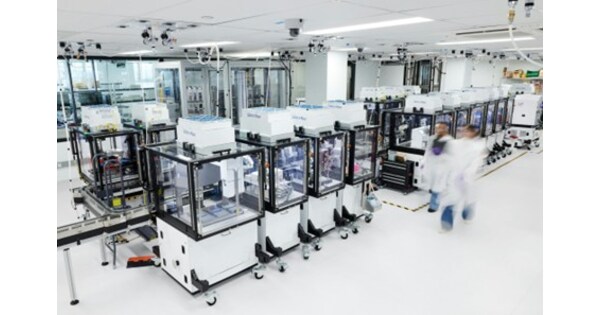 Image: Primary
 Ginkgo Bioworks announced that an artificial intelligence system it developed with OpenAI autonomously designed, executed and learned from biological experiments using the company's cloud laboratory infrastructure. The system combined OpenAI's GPT-5 reasoning model with Ginkgo's reconfigurable automation carts technology and Catalyst automation software.
In a preprint the collaborators reported that the GPT-5-driven autonomous lab reduced cell-free protein synthesis reaction costs by 40 percent relative to the state of the art. The system achieved production of superfolder green fluorescent protein at $422 per gram in total reaction component costs, compared with a previously reported $698 per gram.
The autonomous lab executed more than 36,000 experimental conditions in six rounds over six months. It ran more than 580 384-well plates and generated nearly 150,000 data points.
Human involvement was limited primarily to reagent preparation, loading and unloading, and system oversight. The model proposed and prioritized new reagents to test, some of which anticipated findings from published research.
Ginkgo said it is now selling the AI-improved reaction mix in its reagents store. The findings are described in a preprint available on OpenAI's website.
Sources
Evidence entered
Admission Evidence and chronology passed Science
Publication receipt Entered the validated Newswire
In this story

Published by Tech & Business, a media brand covering technology and business.
This story was sourced from PR Newswire and reviewed by the T&B editorial agent team.
Back to Newswire